You don’t need to train for a marathon—
But you do need to train like an athlete.
As equestrians, we expect our horses to be strong, supple, focused, and fit. We invest in their recovery, their conditioning, their long-term soundness. But what about us?
Too often, we sideline our own physical health—pushing through sore hips, weak cores, and rounded shoulders with a shrug and a “the horse comes first.”
But here’s the truth: when you train yourself like the athlete you ask your horse to partner with, everything changes.
You ride stronger.
You recover faster.
You last longer—not just through a lesson, but through a whole season.
This training split is how I stay in the game. It supports my posture, reduces pain, improves my seat, and helps me show up as a better, more balanced rider—every time I swing a leg over.
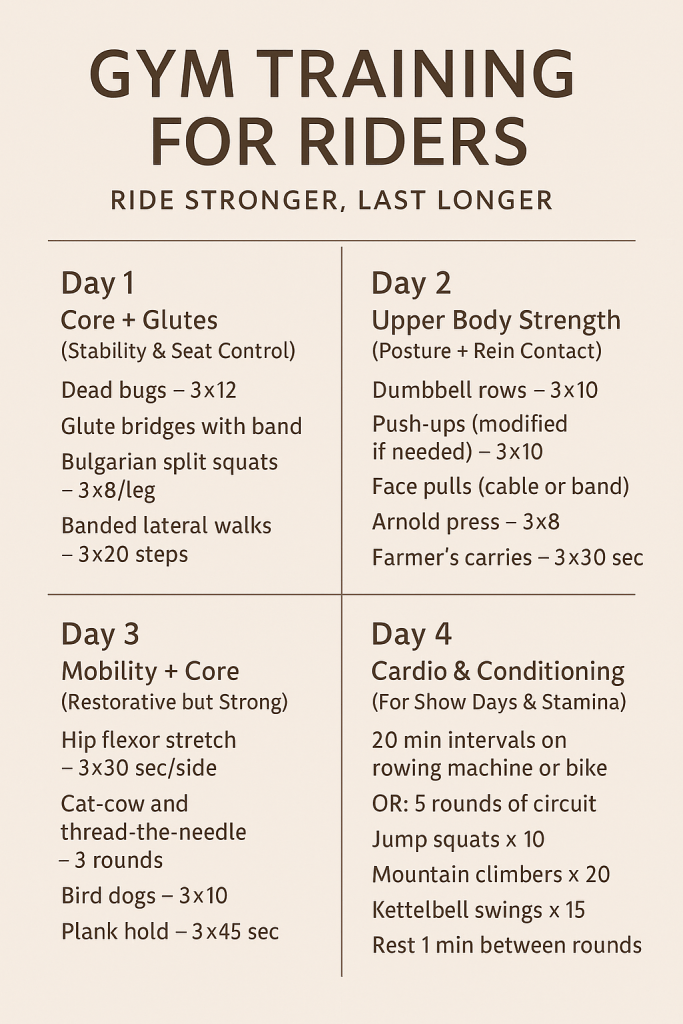
Your Weekly Training Plan
This four-day split blends strength, mobility, and conditioning, all with the rider’s body in mind. You can do it at a gym, or modify it at home with resistance bands and dumbbells.
Day 1 – Core + Glutes (Stability & Seat Control)
Your seat is your foundation.
Glute strength absorbs impact and keeps you centered. Core stability lets you move with—not against—your horse.
Workout:
Dead bugs – 3×12 Glute bridges with resistance band – 3×15 Bulgarian split squats – 3×8/leg Banded lateral walks – 3×20 steps Side plank with leg lift – 3×30 sec/side
Why it matters:
Anchored glutes = a quieter, more shock-absorbing seat.
A strong core = less tipping in corners, better balance over fences.
Day 2 – Upper Body Strength (Posture + Rein Contact)
A rider’s upper body should be open, stable, and responsive—not rigid. This workout supports posture, rein connection, and overall body awareness.
Workout:
Dumbbell rows – 3×10 Push-ups (modified if needed) – 3×10 Face pulls (cable or band) – 3×12 Arnold press – 3×8 Farmer’s carries – 3×30 sec walk
Why it matters:
A strong, quiet upper body allows for subtle, independent aids—and helps reverse the slouched posture caused by mucking stalls or sitting at a desk.
Day 3 – Mobility + Core (Restorative but Strong)
Rest days don’t have to mean no movement. This session keeps your joints mobile, your core activated, and your longevity intact.
Workout:
Hip flexor stretch – 3×30 sec/side Cat-cow and thread-the-needle – 3 rounds Bird dogs – 3×10 Plank hold – 3×45 sec Foam rolling + breathwork – 5–10 min cooldown
Why it matters:
Mobility supports longevity. Quiet strength protects your spine and seat. This is how you ride for years, not just for seasons.
Day 4 – Cardio & Conditioning (Show Day Simulation)
Whether you’re walking a massive course, riding multiple horses, or showing in 90-degree heat—you need stamina. This day builds grit.
Option 1: Intervals (bike or rower)
30 sec fast effort 90 sec recovery x10 rounds (20 minutes total)
Option 2: 5-Round Conditioning Circuit
Jump squats x10 Mountain climbers x20 Kettlebell swings x15 Rest 1 min between rounds
Why it matters:
Quick bursts. Fast recovery. Endurance under pressure. This is how you train for the ring—before you ever step into it.
Train Like You Ride: With Intention
You’re not “just” a rider. You’re an athlete.
And your horse isn’t the only one in the arena doing hard things.
The more I’ve committed to training for riding—not just riding—the better everything has felt. Fewer aches. More balance. More confidence walking into the ring. And a deeper respect for the work I ask of my horse.
We ride against the grain by making space for our own health.
By showing up in the gym with the same intention and intensity we bring to the barn.
So the next time you’re checking saddle fit, wrapping legs, or prepping electrolytes—pause and ask yourself:
Did I take care of me, too?
 Riding Against The Grain
Leave a comment